This post was written by

David Porter | Deosan Dairy Hygiene


From 2021, most milk processors will be recommending the use of Chlorine-Free detergents on dairy farms.

“Removal of chlorine from cleaning routines would significantly reduce the risk of Chlorine residues in milk and consequently, residue levels in the final products, such as lactic butter and milk powder. “


In term of Chlorine residues such as Trichloromethane (TCM) or Chlorate, these can affect iodine metabolism in infants and causes butter quality issues respectively. Even a small level of cross contamination will result in high levels of Chlorate in milk.


Top Tips to Make Your Dairy Parlour a Chlorine-Free Zone

  • Measure and record the size of your wash troughs
  • For rinsing (before and after the detergent wash), Teagasc recommends the use of 15 litres of water per milking point
  • Ensure you only use Chlorine-Free Detergents that are on the Teagasc Approved list
  • Read carefully the drum label before use
  • Strictly only use the recommended rate of detergent. NEVER go above this rate
  • Use appropriate safety measures such as gloves and goggles when handling chemicals
  • The hot detergent solution should be circulated for 8 minutes and dumped before the temperature falls below 54 degree C
  • Ensure Automatic washing systems have been calibrated by a qualified technician annually to ensure the correct chemical usage.


To see our range of detergents click here

For any further info you may require on switching to Chlorine-Free Detergents call us now on 023-8841115.

This post was written by

Paula Egan| Supervising Pharmacist at McLaughlins Pharmacy

It’s a busy time on the farms at the moment (when isn’t it busy I hear you ask!?).  Farmers across the country are delighted with this good weather but as with most things in life –  where there is good, there is bad.
Outdoor workers have a higher than average risk of skin cancer.  UV rays (which damage the skin) are strongest from 11am – 3pm April to September, even on cloudy days. A study taken by the Irish Cancer Society found that UV levels were high enough to cause skin damage almost 90% of the days between April to September.
I know you have probably heard about being “Sun Smart” a million times but I want to remind you how important it is, and how quick and easy it is to do.
  • Cover up  – sun hat, sunglasses with UV protection, loose long-sleeved shirt (to avoid the traditional “T-shirt tan”!)
  • Seek shade – especially between 11am – 3pm when UV rays are strong
  • Apply sunscreen at least 20 minutes before going outside and reapply regularly (every 2 hours and more often if sweating)

A top tip is to have a bottle of sunscreen beside the teabags in the kitchen! I did this with my Dad to “remind” him to use the sunscreen!   


Also it’s really important to keep yourself well hydrated in hot weather.  I’m not a big fan of lukewarm water but I am quite partial to warm dilute orange!! So fill up a big bottle of orange (or flavour of your choice – go mad and try the tropical one!) and bring that with you in your tractor (along with your sunscreen)
The Irish Cancer Society have a fantastic website with loads of information – make sure you check it out.
Keep well, keep safe and keep smiling!
For any ‘Farmer Care’ items that you need, our Pharmacy stock a wide range of products to help you look after you! Simply check out our Farmer Care tab here or alternatively call us on 023-8841115.
McLaughlin’s Pharmacy is adjoined to McLaughlins Farmcare here in Bandon, Co. Cork.

This post was written by

Sophia Kingston| Graduate Agri Advisor with McLaughlins Farmcare


Timmy Crowley is a dairy farmer located at Careys Cross near Bandon, Co. Cork. Timmy was the winner of the Grass10 Grassland farmer of the year 2017. He knows the importance of maximising grass utilisation for grazing and silage. Weed control is of huge importance on this farm. Timmy knew it was a priority to control the weeds at the right time. Here 16 acres of broad-leaved docks, chickweed and dandelion are controlled using Forefront T.


On this recently acquired support block in Bandon, we see an unbelievable result from Forefront T, used at the recommended rate. Timmy said that “The docks withered away to nothing”.

Weed-infested grazing pastures are now approaching the stage for treatment. When it comes to product selection, Forefront T is a perfect choice.

It contains the most advanced chemistry in weed control technology. It is powerful on docks, thistles, nettles and other pernicious weeds such as buttercups and dandelions, making it the ideal all-purpose weed killer. Forefront T is also highly effective on ragwort.

Apply Forefront T as a single application at two litres/ha in 200-300 litres water/ha. Keep stock off the pasture for seven days after spraying. Forefront T does not result in any check to grass growth.
“April and May are the ideal months to spray docks in grazing pastures. If docks have gone beyond the correct stage, it is best to top them and wait for three weeks to spray with Forefront T.

Using the right weed-killer and spraying at the right time is crucial to effective dock control. Using a product that will not damage grass growth and silage yields is another vital consideration.
According to Sophia Kingston with McLaughlin’s Farmcare, timing has a huge bearing on the level of control. She said the ideal time to spray with Forefront is when docks are six to eight inches high or across and before a seed head begins to show. This is called the rosette stage.

Thistles should have four to 10 leaves and be 15-25 cm high. Spray nettles before flowering.

If ragwort is among the target weeds, keep the stock off the treated area until the plant has fully died and disappeared.

If you wish to learn more about Weed Killer in Grazing Pastures please contact the team at McLaughlins


Patrick Cashman | Goldcrop Limited


When to mow silage is an important consideration when maximising both silage quality and silage yield.
  • Too soon and the crop may not have reached its full growing potential.
  • Too late may cause an excessive accumulation of stem and dead material which can be detrimental to silage quality.
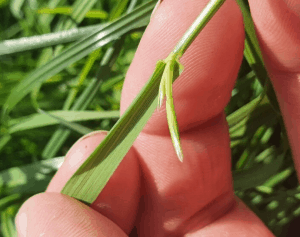
  • Targeting the crop when 50% of the ears have emerged will give the best combination of silage quality and yield.
After a good wilt of 24 hours
  • It is important to get the chopped grass into an air-tight environment as quickly as possible.
  • Getting the silage well packed and covered with robust covering as quickly as possible will achieve this.
  • Extra effort here will reduce wastage during winter and lost feed
Once silage in harvested
  • It is important to consider the yield and if some areas are offering disappointing performance.
  • Lost silage yield can lead to forage shortages in future with resulting additional cost to buy feed.
  • Some investigation can tell if soil nutrients are deficient or if some silage areas need reseeding. Reseeding can offer a really good return in silage ground by returning larger quantities of better-quality home-grown feed.


Ear recently emerged on a perennial ryegrass tiller


Diamond Intensive Silage Grass Seed Mixture (available here)


  • Diamond Intensive Silage (39% Tetraploid) grass seed is suitable for a combination of high yielding & high persistent silage grasses. The combination of three types of grass makes the Diamond Intensive Silage ideal for early spring grazing and gives a high two cut silage yield.
  • All Diamond brand grass seeds have been tested with Teagasc for the past five years to ensure maximum results. Sow Diamond Intensive Silage grass seed is at the rate of 14 – 16 kg per acre of land, as per recommendation.


Plant & Soil Solutions Ltd is an Irish based company which was started by Padraig Shevlin, who has worked in the Agriculture industry for the past 7 years specialising in soil and crop management. Plant & Soil Solutions offers a comprehensive soil testing service including the base saturation soil tests. We offer technical growing advice on a wide range of crops/grassland/potatoes and vegetables to produce the quantity as well as quality products. This is backed up by our bespoke range of quality products that include seaweed bio-stimulants, foliar and granular trace elements as well as a specific range of biologicals.

Padraig has been working closely with McLaughlins for a number of years.  Working alongside the sales team in McLaughlins they distribute our products through the Cork region. The team in McLaughlins have an in-depth understanding of the products, supported on the ground by Padraig’s expertise. These products include:

In-depth soil analysis

Seaweed bio-stimulants

  • MariGro
  • MariPhos

Foliar trace element

  • MagK+

Granular trace elements

  • G Boron
  • G-Zinc
  • G Manganese

Biologicals

  • PhosNitro-Mór
  • Root crop-Mór
  • Slurry-Mór


Barry Murray MSc | Chief Agronomist Goldcrop Limited

2020 saw the introduction of new measures with regards to clover usage for those farmers who are in, or were about to enter, Nitrates Derogation 2020.   All new reseeds must contain 1.5 kg/ha (0.6 kg/ha) of naked clover.  This includes white clover varieties such as Chieftain in grazing mixtures. Red clover varieties such as Fearga in silage mixtures is another example.

What Should a Progressive Farmer look for in a Grass Seed Mixture?

Reseeding is a vital part of keeping any livestock farm productive and profitable.  Every farm should aim to reseed at least 10% of the farm annually, regardless of weather conditions.  Modern recommended list grass varieties offer improvements in yield and digestibility over older material by the very nature of being on a recommended list.  Anything that is new on the Irish Recommended List must offer improvements on any variety that it replaces.  This ensures genetic progress is carried through from a research-level to an on-farm commercial scenario. Reseeding also offers an opportunity to control difficult weeds such as docks, thistles and unproductive grass weeds such as creeping bent and scutch.

Cork is a county that has a rich tradition of dairy farming and has one of the largest dairy herds in the country at nearly 390,000 cows.  With peak cattle and calf numbers in the early spring coupled with on/off grazing practices that might be employed during difficult weather periods in the spring, the mixtures that contain varieties which have the following characteristics are vital:

  • High Spring growth
  • High Ground Cover Scores
  • Great Palatability (i.e. high grass intake and as a consequence higher milk yields and live weight gain)
  • Ability to stretch grazing between rounds without getting stemmy
Varieties that would satisfy that would include:
  • Astonking – a new very high yielding late diploid with exceptional spring growth
  • Meiduno – An exceptional late tetraploid variety with unreal spring growth and high total yield
  • Astonenergy – the best ever  variety for graze out, digestibility and animal performance 
  • Oakpark – The highest ground cover score late diploid on the recommended list that offers excellent seasonal growth and is also suitable for silage if required

Information from research farms such as Teagasc Moorepark and Clonakilty Agricultural College must also be considered.  These are some of the leading research farms in the world and are on our doorstep. The research that is carried out, particularly the livestock grazing trials must be considered. This is because they operate under the same regimes as many leading dairy farms. 


https://www.agriland.ie/farming-news/check-out-this-new-reseed-from-beginning-to-end/