Irish Owned
This post by
Liam Lacey | Inform Nutrition
The importance of vitamins and minerals in the diet of cattle
Vitamins, minerals and trace elements play a key role in metabolism, immunity and health, growth and production, reproduction and fertility. Mineral deficiencies can result in significant problems on farm with reduced production, poor fertility and increased health problems.
Why feed minerals to cattle?
The McLaughlins Farmcare mineral for Dairy cow range
Formulated for a higher production cows
- higher yields & longer lactations imply a higher requirement for minerals and trace elements,
- higher volume of milk produced indoors increased vitamin requirements
- Longer winters means more silage fed, cows are on concrete for longer (feet –chelated zinc). Harder wetter surface, wet softens the keratin in the hoof rendering it more susceptible to injury
- Silages grown in wetter conditions have higher levels of mineral antagonists (molybdenum and Iron)
- Higher production – higher levels of feed with higher levels of starch fed increased risk subclinical acidosis. Increased risk of laminitis, softer hoofs (increase risk white line and abscess), reduced body condition score, reduced production
Given above how can we help the cow
- Optimum levels of vitamins and minerals and trace elements for a healthy cow and calf
- High levels of magnesium to support a reduction in risk of milk fever and related issues
- High levels of vitamins to improve colostrum quality
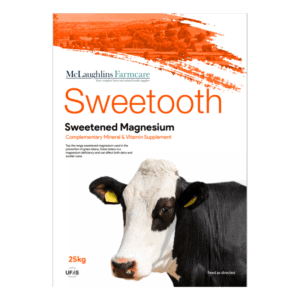
Sweet-tooth
Magnesium is the most important element to supplement to pre calved cows. McLaughlins Farmcare Sweet-tooth contains high levels of Magnesium. If extra supplementation of magnesium is required due to high DCAD silage diets then sweet-tooth is the ideal supplement to accompany it. A highly palatable form of water soluble magnesium is a great tool in the defence against the main issues around calving time, Milk fever (hypocalcaemia) and retained cleanings.
High potassium silages cause these main issues usually. Ones that interfere with magnesium absorption. This plays a critical role in the mobilisation of calcium from the bone after calving.
Chelated copper
Roles in the cow
- Plays and important role in many metabolic reactions – affects production or weight gain
- Important role in fertility – release of (Luteinising hormone) get anoestrus
- Immune system
Adding as glycine chelate. These are small molecules and are directly absorbed by the cow. This improves the copper metabolism in the cow. Copper metabolism can be compromised by one or a combination of the following,
- Low copper intake(all Irish forages have low levels of copper relative to animal requirements)
- High levels of mineral antagonists (Iron and molybdenum). A significant portion of forages produced in the West will have high levels
Zinc
Role
- Metabolism & appetite
- Immune system implications for cell count
- Formation of keratin – skin and hoof. Keratin is also an important tissue in the mammary gland
One of the main rationales for adding zinc chelate is to improve hoof quality particularly the integrity and hardness of the hoof and make it less susceptible to injury
Selenium
Role
- Forms important antioxidant -peroxidases, play an important role in the immune system. Implication for health and cell count
- Fertility and productivity
- Muscle
Levels of selenium are low in all forages. Molybdenum and dietary calcium level have an effect on metabolism and absorption in the gut. Inorganic sources have to be chelated in the gut to be absorbed. This process has happened already in the yeast which is the source of protected selenium.
When to feed minerals
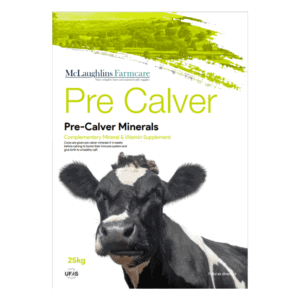
It is important to feed pre calver minerals to cows for at least 8-10 weeks pre calving as any deficiency will not be corrected in a shorter time period. Continuous supplementation is more important to the animal than feeding higher levels of a nutrient that may be lacking for example Iodine. An animal has only the ability to absorb a certain amount of these nutrients daily so extra supplementation will not be effective and only secreted.
How to feed
Dust the powder on the silage at the required feed rate daily and to scatter it across all the silage not distribute out in a line. The minerals can also be administered via diet feeding but watch out for dry mixes as the mineral may fall through the mix and be swept out in left over feed.